

ITR Deadline AY 2026-27: Why You See 31 July, 31 August and 15 September
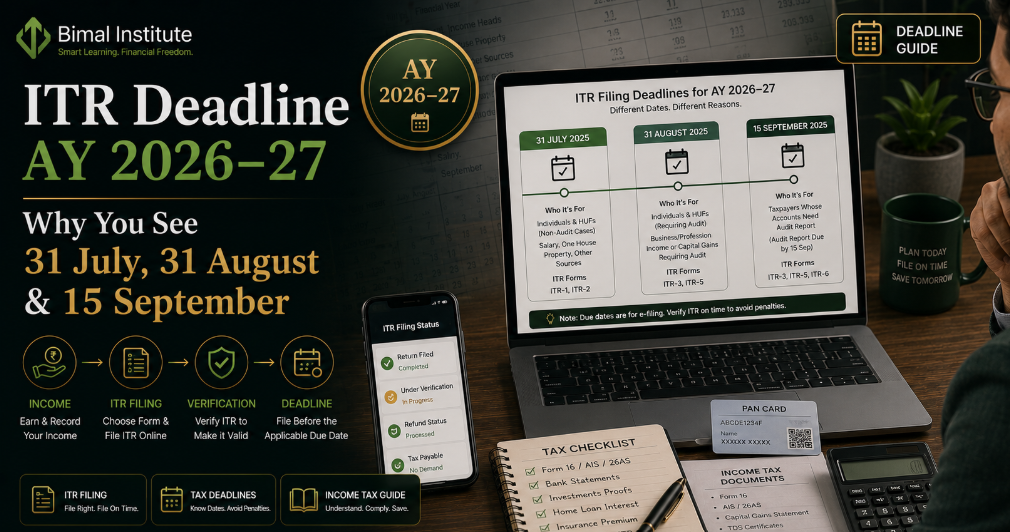
Search for the income tax return deadline this week and you will get three different answers. The confusion is real, and it comes from a recent rule change that most trackers have not caught up with.
Quick answer: For AY 2026-27, the widely reported deadlines are 31 July 2026 for salaried filers using ITR-1 or ITR-2, and 31 August 2026 for non-audit business and professional filers using ITR-3 or ITR-4. The 15 September date many pages still show was last year’s one-time extended deadline. Always confirm the current date on the official portal.
Why Three Dates Are Floating Around
The short version: one date is current, one is new, and one is left over from last year.
For the previous cycle, AY 2025-26, the government extended the salaried deadline from 31 July to 15 September 2025, and then by one more day after the portal glitched. Many websites simply carried that 15 September figure forward, which is why you still see it.
The genuinely new element is a split. From AY 2026-27, salaried and business filers no longer share a single 31 July date, and that is the change worth understanding.

Which Date Actually Applies to You
Your deadline now depends on which form you file, not just on the calendar. Here is the widely reported staggered calendar for AY 2026-27.
| Who you are | Form | Reported due date |
|---|---|---|
| Salaried, pensioner, non-audit | ITR-1 or ITR-2 | 31 July 2026 |
| Business or professional, non-audit | ITR-3 or ITR-4 | 31 August 2026 |
| Accounts requiring audit | As applicable | 31 October 2026 |
| Transfer pricing cases | As applicable | 30 November 2026 |
Multiple tax portals report that the 31 August window for non-audit ITR-3 and ITR-4 filers was introduced as a lasting change from AY 2026-27, not a one-off extension. That is what separates this year from the past.
If you are a salaried employee or a stock market investor whose accounts are not audited, the date on your calendar is 31 July 2026. Traders and investors reporting capital gains fall here too, which is why it helps to first understand how trading and investment profits are taxed in India.
Should You Wait for an Extension?
The honest answer is no, do not plan around one. An extension is possible, but it is never guaranteed and only becomes real through an official CBDT notification.
Reporting this year suggests the tax department has released the ITR forms and filing utilities early, which removes the main reason deadlines were pushed in the past. Waiting for a repeat of last year’s last-minute reprieve is a gamble, not a strategy.
Filing early has concrete upsides anyway: faster refunds, fewer portal glitches in the final-day rush, and time to fix errors. First-time filers often overestimate how complex it is, in the same way many overestimate how much money it takes to start investing.

What Missing the Deadline Costs
Missing your date does not lock you out, but it is not free either. A belated return can generally be filed up to 31 December 2026, with two clear costs.
- Late fee under Section 234F: up to Rs 5,000, reduced to Rs 1,000 if your total income is up to Rs 5 lakh.
- Interest under Section 234A: charged on any unpaid tax until you file and pay.
- Lost benefits: you cannot carry forward certain business and capital losses, and a belated return can block switching to the old regime for that year.
If you spot a genuine mistake after filing, a revised return can generally be filed up to 31 March 2027. That is a correction window, not a substitute for filing on time.
How to File on the Income Tax Portal
The process itself is straightforward once your documents are ready. Log in to the official income tax e-filing portal using your PAN as the user ID, then go to e-File, then Income Tax Return.
Select Assessment Year 2026-27 and the correct ITR form for your income. Before submitting, cross-check every entry against your Form 16, Form 26AS and the Annual Information Statement, since mismatches are the most common reason returns get flagged.
One step people skip at their peril: e-verification. An unverified return is treated as never filed, so complete e-verification within 30 days through Aadhaar OTP, net banking or EVC.

Frequently Asked Questions
What is the ITR deadline for AY 2026-27?
The widely reported dates are 31 July 2026 for salaried filers using ITR-1 or ITR-2, and 31 August 2026 for non-audit business and professional filers using ITR-3 or ITR-4. Confirm the current date on the official portal.
Why do I see 31 July, 31 August and 15 September?
31 July applies to salaried ITR-1 and ITR-2 filers, 31 August to non-audit ITR-3 and ITR-4 filers, and the 15 September figure was last year’s one-time extended deadline for AY 2025-26 that many sites still display.
Which date applies to salaried people?
31 July 2026, for those filing ITR-1 or ITR-2 whose accounts do not require an audit. Stock market investors reporting capital gains generally fall in this group too.
What about business and professional income?
Non-audit filers using ITR-3 or ITR-4 have a reported deadline of 31 August 2026, which several portals describe as a permanent change under the Finance Act 2026.
Is the deadline being extended this year?
No extension should be assumed. Reporting suggests the forms and utilities were released early, and any extension would only be valid through an official CBDT notification.
What is the penalty for late filing?
A late fee under Section 234F of up to Rs 5,000, reduced to Rs 1,000 if total income is up to Rs 5 lakh, plus interest under Section 234A on any unpaid tax.
Can I file after the deadline?
Yes, a belated return can generally be filed up to 31 December 2026, but with the late fee, interest, and loss of certain carry-forward benefits.
What is a revised return?
If you find an error after filing, a revised return lets you correct it, generally up to 31 March 2027 for AY 2026-27, subject to the rules in force.
How do I file on the income tax portal?
Log in at incometax.gov.in with your PAN, go to e-File then Income Tax Return, select AY 2026-27 and your ITR form, verify entries against Form 16, Form 26AS and the AIS, then submit.
Do I still need to e-verify my return?
Yes. An unverified return is treated as never filed. Complete e-verification within 30 days of submission using Aadhaar OTP, net banking or EVC.
What is AY 2026-27?
Assessment Year 2026-27 is the year in which you file and are assessed for income earned in Financial Year 2025-26, that is, income earned between 1 April 2025 and 31 March 2026.
Does the new Income Tax Act 2025 apply to this return?
No. Returns for income earned in FY 2025-26 are filed under the Income Tax Act, 1961, even though filing happens after the new Act came into force. The official portal states this clearly.
Where do I confirm the official date?
Only on the Income Tax Department’s e-filing portal or through an official CBDT notification. Third-party trackers can lag behind or repeat an old year’s date, so treat the portal as the final word.
View this profile on Instagram
View this profile on Instagram
If you want to understand how tax on salary, capital gains and trading actually fits together before you file, start with Bimal Institute’s free trading course.
Note: Tax deadlines, penalties and rules are governed by the Income Tax Act and CBDT notifications and can change at short notice. The dates above are as widely reported and may be revised, so verify the current deadline on the official income tax portal before filing. This article is for information and education only and is not tax or legal advice; consult a qualified professional for your specific situation.