

EPFO Portal Is Back and PF Transfers Just Got Easier, But One Small Mismatch Can Still Kill Your Claim
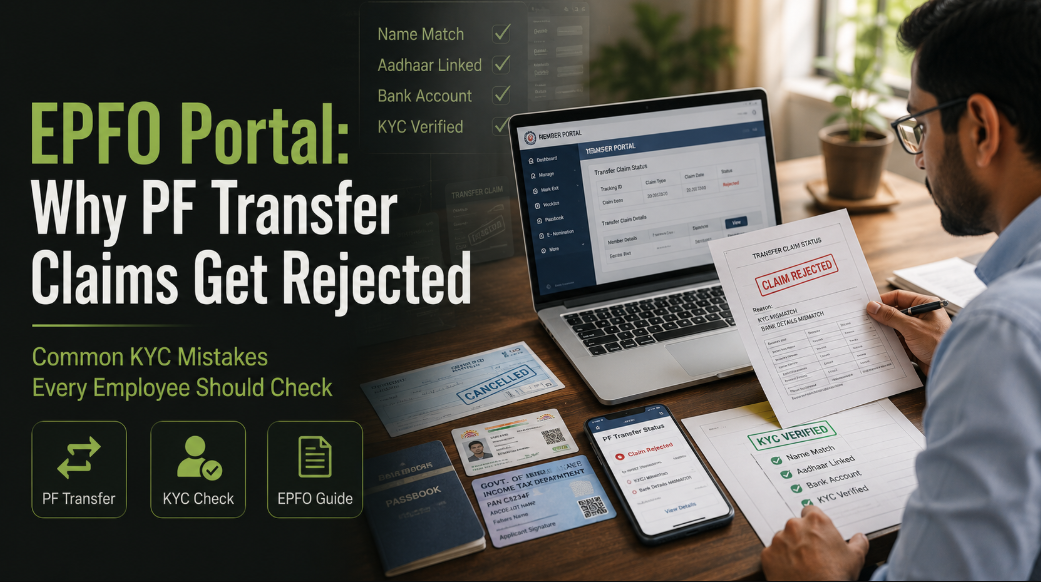
A faster system does not mean a successful claim. Here is what actually changed on the EPFO member portal, what EPFO 3.0 really is, and the four checks that decide whether your money moves or bounces back.
Most PF claims do not fail because of a big mistake. They fail because of a letter.
A name saved as “Amit S.” at the bank but “Amit Sharma” on the EPFO portal. An IFSC code that quietly stopped existing after your bank was merged. A KYC entry sitting at “Pending” because nobody in HR clicked approve.
The EPFO member portal is back online after a major technology upgrade and database consolidation, and it has returned with some genuinely useful additions. But here is the part most people are missing: the new system changes how fast your money moves, not whether it moves at all. That part is still decided by your records.
What actually changed on the portal
The headline change is PF transfer after a job switch. Members can now start a transfer through two different routes on the member portal instead of one.
Route 1: Request for Transfer of Account. The familiar option, sitting under the Online Services section.
Route 2: Member Service History. This is the new addition. Log in with your UAN and you can view your current and previous employment records, check whether a transfer request is already pending, and start a Service Transfer Claim through Form 13 if none exists.
The second route matters because it removes guesswork. Earlier, many members filed duplicate transfer requests simply because they had no easy way to see whether one was already in progress. Business Standard reported the addition as part of EPFO’s wider digital modernisation push.

The flow itself is straightforward. Enter your previous employer’s Member ID, verify and fetch the account details, authenticate with the OTP sent to your Aadhaar-linked mobile number, confirm that the destination account linked to your current employer is correct, and submit.
View this profile on Instagram
One honest caveat: EPFO has said some claims, transfers and service requests may still take longer than usual while the upgraded systems settle down. Filing early is smarter than filing in a hurry.
EPFO 3.0: what is true and what is just WhatsApp
You have probably seen the forwards. PF withdrawals through UPI. ATM-like access. Instant money. Some of it is real. Some of it is not, at least not yet. A Business Today fact-check cut through most of the noise.
Not live yet. UPI and ATM-style withdrawal has been announced, but there is no official launch date. Until it actually rolls out, withdrawals continue through the existing claim process.
No new withdrawal limit. The proposed facility changes the payment channel, not the rules. You will still be able to withdraw only what you are already eligible to withdraw. No separate UPI or ATM limit has been notified.
Most of it is invisible. EPFO 3.0 is largely a backend overhaul: a unified, banking-style IT platform, a higher auto-settlement limit of Rs 5 lakh, and a centralised pension payment system.
You do not need a new account. Existing members carry forward automatically under the EPF Scheme, 2026, with accumulated savings protected.
Contributions are unchanged. Employees and employers continue to contribute 12 per cent of wages, subject to the statutory wage ceiling of Rs 15,000 a month. If you want a bigger corpus, that is what the Voluntary Provident Fund is for, and it is worth knowing how much a steady monthly contribution can actually build over a full career.
View this profile on Instagram
The uncomfortable number: one in five
EPFO’s own annual report shows that nearly one in five claims filed in 2024-25 were rejected. Not because of fraud. Because of mismatched Aadhaar, PAN, UAN or bank details, names that did not line up, wrong dates of birth, or exit dates that a previous employer never updated.
The system is automated. It checks your details in real time. If something does not match, the claim simply fails. A faster payment rail cannot fix a wrong record.
Four checks to run before you submit anything
| Check | What must be true |
|---|---|
| Bank details | Correct account number, the current IFSC (not a pre-merger one), and a name that matches your bank records letter for letter |
| KYC status | Must show Approved by your employer. “Pending” or “Under Review” means your claim will not go through |
| Aadhaar and PAN | Both must show as verified on your UAN profile, not merely uploaded |
| Bank document | A clear cancelled cheque or passbook front page. Blurry, dark or cropped images get rejected |
Two things are worth knowing here.
PAN decides your tax. If you withdraw more than Rs 50,000 with less than five years of service, TDS applies. With a verified PAN on your EPFO profile, it is deducted at around 10 per cent. Without one, it can climb to roughly 30 per cent. That is an expensive blank field, and the same PAN discipline shows up again when you sit down to file your return, as our ITR filing guide for AY 2026-27 explains.
Ignore the myth about the income tax portal. EPFO does not verify your bank details through your income tax e-filing login. The check happens inside its own system, between your UAN profile, your employer-approved KYC and your bank.
Transfer beats withdraw, almost always
Switched jobs and thinking of just cashing out? Consider what a transfer protects: your accounts get consolidated, your continuous service record stays intact, your eligibility for higher pension benefits is preserved, and you avoid TDS that can hit premature withdrawals.
Then there is the quiet math. EPF pays 8.25 per cent for FY26 and it compounds, which is why EPF still outpaces most bank fixed deposits and why the rate has held up well across the last decade. Money pulled out at 30 rarely feels like a big loss. At 60, it does. If you want the arithmetic, see how much your PF actually grows in a year and what the credited interest looks like in rupees.
Before you hit submit
- Bank details on the portal are current and correct
- KYC shows Approved, not Pending
- Aadhaar is seeded and verified against your UAN
- PAN is saved and verified on your EPFO profile
- Your uploaded bank document is sharp and fully readable
Fix these once, and the new portal will do exactly what it promises. Skip them, and no amount of technology will help.
Frequently asked questions
Can I withdraw my PF through UPI right now?
No. The facility has been announced, but there is no official launch date. Withdrawals continue through the existing claim process.
Do I need to open a new PF account under the EPF Scheme, 2026?
No. Existing members continue automatically, and accumulated savings stay protected.
Why do PF claims get rejected so often?
Almost always because of record mismatches: bank details, name spelling, Aadhaar, PAN, date of birth, or an exit date your old employer never updated.
Should I transfer my PF or withdraw it after changing jobs?
Transferring is usually the better option. It preserves continuous service, keeps your savings compounding, and avoids TDS that can apply to premature withdrawals.
Understanding how money compounds is the same skill that separates disciplined investors from impulsive ones. If you want to build that skill properly, start with our free trading course at Bimal Institute.
Disclaimer: EPFO rules, portal features and rollout timelines change frequently. Always confirm the current position on the official EPFO portal or the UMANG app before filing a claim. This article is for information only and is not financial or tax advice.