
Bitcoin Is a Coin, So What Is USDT? Coin vs Token Explained
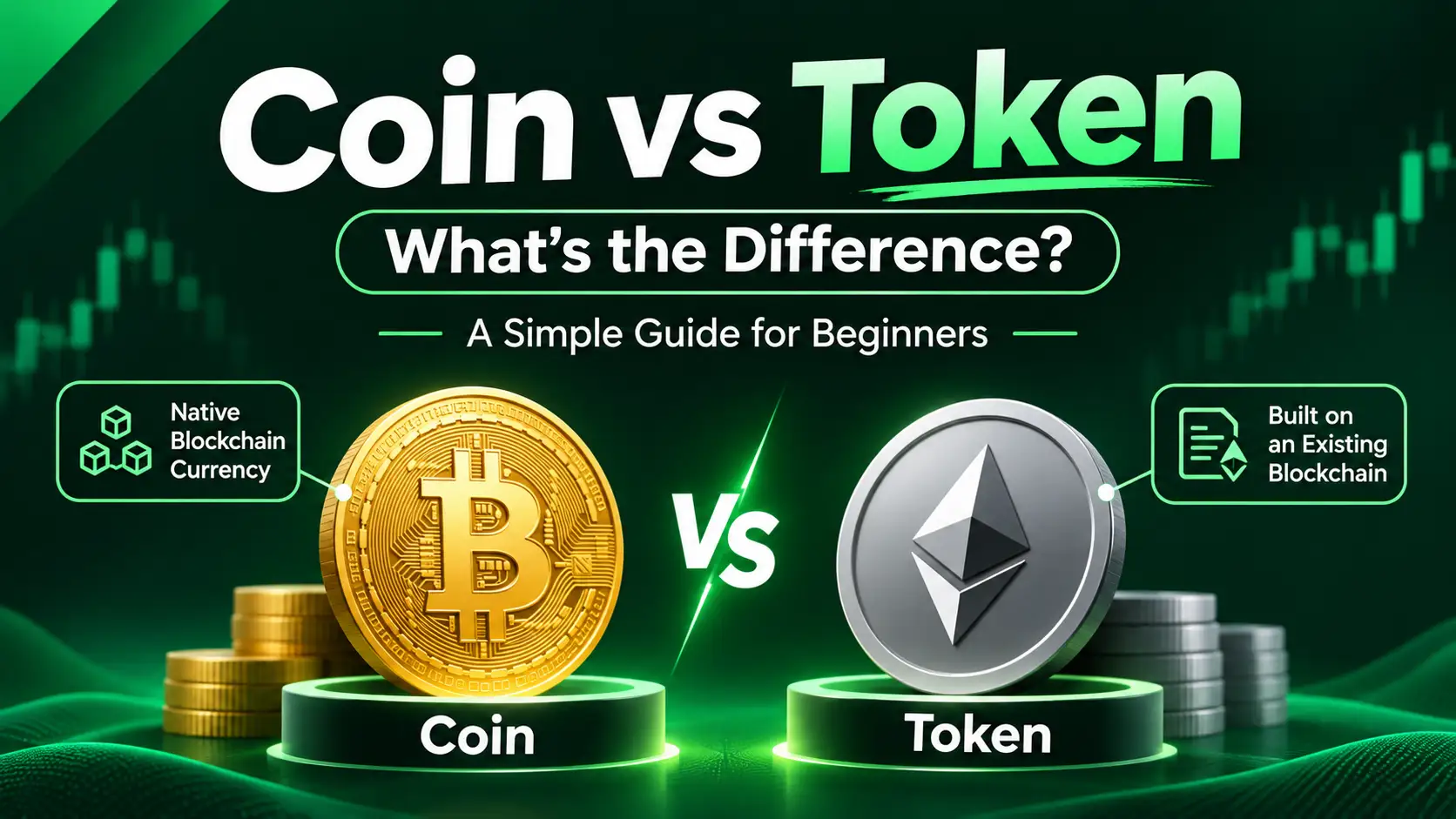
Coin vs token is the simplest way to sort crypto: a coin is a cryptocurrency native to its own blockchain, like Bitcoin or Ether, while a token is an asset built on an existing blockchain, like USDT. Both store value and move between wallets; the difference is which network they call home, and that changes how they behave.
You are at a big city mall. Downstairs you pay for parking with coins the whole building accepts; upstairs, a clothing store hands you a ₹500 gift card that only runs through its own billing counter. Crypto sorts its money the same way, into coins and tokens, and the gift card in your pocket is the clue to how USDT works.
Key takeaways
- A coin is a cryptocurrency native to its own blockchain; Bitcoin is the coin of the Bitcoin network and Ether is the coin of Ethereum.
- A token is an asset built on an existing blockchain using that chain’s rules, such as the ERC-20 standard on Ethereum.
- USDT is a token, not a coin: a stablecoin issued by a company and running on blockchains such as Ethereum and Tron.
- To move a token you pay the fee in the host chain’s coin, so sending USDT on Ethereum needs some Ether for gas.
- In India, coins and tokens are both virtual digital assets (VDAs), taxed at 30% with 1% TDS; neither is legal tender.
Coin vs token: what is the difference?
Coin vs token comes down to one question: does it run its own blockchain, or does it live on someone else’s? A coin is the native currency of its own network, while a token is built on an existing blockchain and depends on that network to work.

In the mall, a coin is the currency the whole building runs on, and a token is a gift card a shop issues inside that building. The table sets the two side by side.
| Feature | Coin | Token |
|---|---|---|
| Where it lives | Its own blockchain | On another blockchain |
| Examples | Bitcoin, Ether | USDT and other ERC-20 tokens |
| Who creates it | The network, through mining or validation | A project or company, through a smart contract |
| Pays the network fee | Yes, it is the fee currency | No, you need the host chain’s coin to move it |
| Can it exist without a host chain | It is the chain | No, it needs a blockchain to live on |
What is a coin in crypto?
A coin is a cryptocurrency that is native to its own blockchain and is used to pay that network’s fees. Bitcoin is the coin of the Bitcoin network, and Ether is the coin of Ethereum.
Coins are created by the network itself, as rewards to the computers that process and secure it. They also pay what is called gas, the fee to record a transaction on that chain. In the mall picture, the coin is the building’s own currency that keeps the lights on; without it, nothing inside moves. According to the Bitcoin whitepaper (Nakamoto, 2008), Bitcoin was designed as the network’s own electronic cash, which makes it the original example of a coin.

What is a token in crypto?
A token is a digital asset built on an existing blockchain using that chain’s rules, rather than running a blockchain of its own. On Ethereum, most tokens follow the ERC-20 standard.
According to Ethereum’s documentation, the ERC-20 standard defines a common set of rules, such as how a token transfers and how balances are checked, created by a smart contract rather than by the network. Ethereum’s docs note these tokens are fungible: “1 Token is and will always be equal to all the other Tokens.” USDT is one such token. It is a stablecoin, meaning a token that aims to track the value of a currency like the US dollar, issued by the company Tether and available on several blockchains including Ethereum and Tron. Tokens also power much of decentralised finance (DeFi), where lending and trading run through code.
Why does the coin and token difference matter in practice?
The difference matters most when you move a token, because you pay the fee in the host blockchain’s coin, not in the token itself. Send USDT on Ethereum, and you need some Ether to cover the gas fee.
- You hold a token, say USDT, on a blockchain such as Ethereum.
- You ask your wallet to send it to another address.
- The network charges a gas fee to record the transfer.
- That fee is paid in the chain’s coin, Ether, not in USDT.
- With no coin for gas, the token will not move, even if your token balance is large.
This is also why the same token can exist on different blockchains with different fees, and why choosing the wrong network when sending can lose funds. In the mall, the gift card is only as useful as the building’s billing system that processes it. Each coin or token also carries a market value, tracked as its market capitalisation.
How are coins and tokens taxed in India?
In India, coins and tokens are treated the same for tax: both are virtual digital assets (VDAs). According to the Income Tax Department, income from transferring a VDA is taxed at a flat 30%, plus surcharge and cess.
The definition in Section 2(47A) covers a “token generated through cryptographic means”, so a stablecoin like USDT and a coin like Bitcoin fall under the same rule. A 1% tax deducted at source (TDS) applies under Section 194S on payments to residents, and a loss on one VDA cannot be set off against a gain from another. Neither coins nor tokens are legal tender; only the Reserve Bank of India’s Digital Rupee is. Rules here can change at budget time, so treat this as general information and confirm your own position with a qualified tax professional. For the first steps, see our beginner’s guide to crypto trading in India.
Myth vs Fact
| Myth | Fact |
|---|---|
| Coins and tokens are the same thing with different names. | A coin is native to its own blockchain; a token is built on another blockchain and needs that chain’s coin to move. |
| USDT is a coin like Bitcoin. | USDT is a token, a stablecoin issued by a company and running on chains such as Ethereum and Tron. It is not the native coin of any blockchain. |
| Tokens are taxed differently from coins in India. | Both are virtual digital assets under Section 2(47A); income from transferring either is taxed at 30% with 1% TDS. |
Try it yourself (2 minutes, no money). Open a free public block explorer for the Ethereum network and search for a recent USDT transfer. Notice two separate things on the same page: the amount of USDT that moved, which is the token, and the small fee paid in Ether, which is the coin. Seeing both on one screen is the clearest proof that a token rides on a coin’s network, and you have spent nothing to confirm it.
Risk note. Crypto assets are volatile, and in India they remain only partly regulated; even a stablecoin can move away from the value it aims to hold. This article explains a concept for learning purposes only. It is not investment, tax or legal advice; speak to a qualified tax professional or financial adviser before acting on anything involving VDAs.
If you would rather learn how coins, tokens and blockchains fit together with someone to answer your questions, Bimal Institute’s Crypto & Forex program teaches these ideas from the ground up, with market structure and risk management at the centre. You can explore the Crypto & Forex program to see how it is taught.
Frequently asked questions
Is USDT a coin or a token?
USDT is a token, not a coin. It is a stablecoin that aims to track the value of the US dollar, issued by the company Tether, and it runs on existing blockchains such as Ethereum and Tron rather than on a blockchain of its own. That dependence on a host chain is exactly what makes it a token.
Can a token become a coin?
Yes. Some projects launch as a token on an existing blockchain, then move to a blockchain of their own in a step often called a mainnet swap. After the move, holders exchange the old token for the new network’s native coin. Until that happens, the asset remains a token on its host chain.
Do I need coins to send a token?
Usually yes. To move a token you pay the host blockchain’s fee, called gas, in that chain’s coin. For a token on Ethereum you need some Ether; on the Tron network you need TRX. If you hold the token but none of the host coin, the transfer cannot be processed at all.
Are stablecoins coins or tokens?
Most stablecoins are tokens, despite the word “coin” in the name. A stablecoin such as USDT is issued by a company and built on an existing blockchain, which makes it a token. The name describes its goal, holding a steady value, not the technical category it belongs to.
Is USDT legal in India?
Using and trading USDT is not banned in India, but it is treated as a virtual digital asset, not legal tender. Exchanges must follow KYC and anti-money-laundering rules, income from transferring it is taxed, and the regulatory position can still change. Only the Reserve Bank of India’s Digital Rupee is legal tender.
Sources
- Ethereum Foundation — ERC-20 Token Standard. Checked 28 November 2026.
- Income Tax Department, Government of India — Taxation of Virtual Digital Asset (VDA). Checked 28 November 2026.
- Satoshi Nakamoto — Bitcoin: A Peer-to-Peer Electronic Cash System (2008). Checked 28 November 2026.