

EPF Scheme 2026 Explained: What the Employees’ Provident Fund Overhaul Means for Every Salaried Employee in India
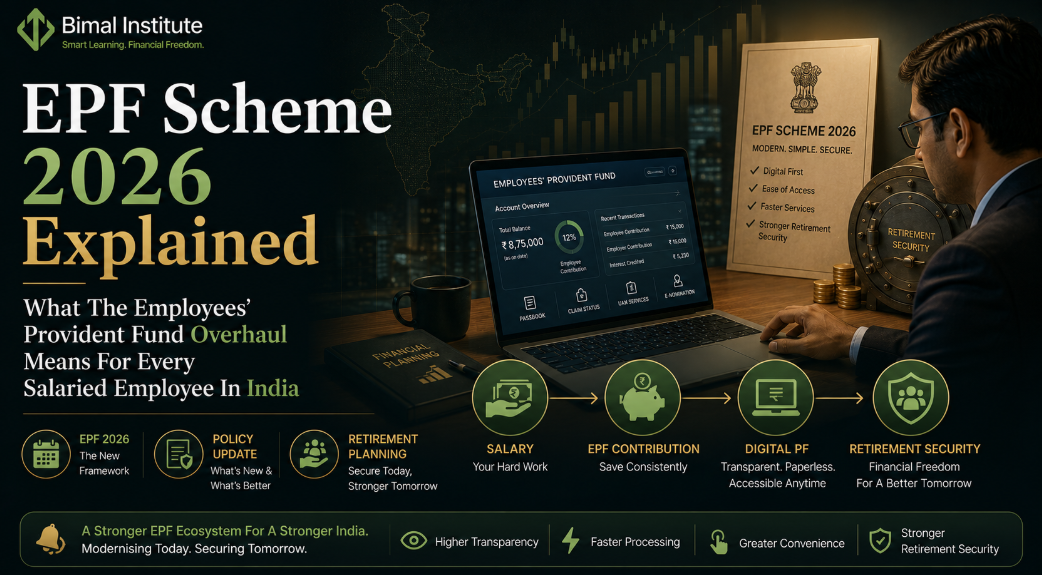
For sixty years, the rules behind your PF barely changed. Then, almost overnight, they did. On 29 June 2026, the government notified the Employees’ Provident Funds Scheme, 2026, retiring the old 1952 scheme. This Employees’ Provident Fund overhaul has left nearly 8 crore salaried Indians asking the same thing: what exactly changed, and does my money stay safe? Here is a clear, honest breakdown.
Quick summary: 5 key takeaways
- The EPF Scheme 2026 replaced the 1952 scheme from 29 June 2026, under the Code on Social Security, 2020.
- Your core contribution (12% plus 12%) and the 8.25% interest rate stay unchanged.
- Withdrawals get simpler, with a uniform 12-month rule and a 25% balance kept back for retirement.
- A new option lets you contribute extra, above the mandatory limit, on a voluntary basis.
- Existing members need to take no action. Your account and UAN continue as before.

What Is EPF Scheme 2026?
EPF Scheme 2026 is the new legal framework for the Employees’ Provident Fund, notified on 29 June 2026 under the Code on Social Security, 2020. It replaces the six-decade-old 1952 scheme, mainly modernising administration and digital services while keeping core benefits intact.

In plain terms, it is a rulebook refresh. The Centre notified it alongside a new Employees’ Pension Scheme (EPS), 2026, replacing EPS-95, to move PF onto the modern Social Security Code and make the system faster and more digital, not to cut benefits.
View this profile on Instagram
Why Did the Government Overhaul EPF?
The government overhauled EPF to modernise a 60-year-old law, align it with the new Social Security Code, cut paperwork, speed up claims, and give members more flexibility, while tightening compliance and governance for employers and PF trusts.

The 1952 scheme was built for a paper era of slow claims, confusing withdrawal rules, and dated governance. The overhaul aims to fix that: simpler rules for employees, stronger accountability for employers, and a digital-first system.
Major Changes Explained
The main changes are simpler withdrawals with a uniform 12-month service rule, a 25% minimum balance kept for retirement, a new voluntary contribution option, faster digital claims, and stricter employer compliance. Core contribution rates and interest remain the same.
Here are the headline shifts, stated as facts from the notification:
- Simpler withdrawals: The earlier 13 withdrawal reasons are consolidated into a few broad categories such as essential needs, housing, and special circumstances. Reports differ on whether this is three or five groups, so treat the exact count as still settling.
- Uniform 12-month rule: Most partial withdrawals now need just 12 months of service, instead of the old 5 to 7 year waits.
- 25% ring-fencing: You can access a large share of your balance for advances, but roughly 25% is kept locked so your retirement corpus survives.
- Voluntary contributions: Beyond the mandatory limit, you may choose to contribute more. Employers may match it but are not required to, and you can stop anytime.
- Emergency flexibility: The Centre can temporarily defer contributions for up to three months during events like pandemics or disasters.
View this profile on Instagram
Old Rules vs New Rules
Under the old rules, withdrawals had 13 categories and long service waits, and the system was paper-heavy. The new rules simplify categories, apply a uniform 12-month rule, ring-fence 25% for retirement, and push digital claims, while keeping contributions and interest the same.
| Area | Old (1952 Scheme) | New (2026 Scheme) |
|---|---|---|
| Withdrawal reasons | 13 separate categories | A few simplified categories |
| Service needed | Varied (5 to 7 years) | Uniform 12 months for most advances |
| Retirement protection | Less structured | About 25% balance ring-fenced |
| Extra savings | Limited flexibility | Voluntary contributions allowed |
| Contribution rate | 12% + 12% | 12% + 12% (unchanged) |
| Interest | 8.25% | 8.25% (unchanged) |
How This Affects Salaried Employees
For most salaried employees, PF contributions and interest do not change. You gain easier, faster withdrawals, a uniform 12-month rule, and an optional way to save more. Existing members need to take no action, and your PF money remains safe.
If your basic pay is Rs 15,000 or less, your contribution does not change. Higher earners will not see an automatic salary rise; that depends on the employer. The real wins are quicker emergency access and clearer rules. See our guides on how your PF grows at 8.25% and what Rs 10,000 a month builds.
How This Affects Employers
Employers face wider compliance under EPF Scheme 2026, including one-time, monthly, and event-based filings, a consolidated Form V within 15 days, and stricter governance for those running their own PF trusts. HR and payroll teams will need to update processes.
| Employer Duty | What It Means |
|---|---|
| Form V filing | Consolidated return within 15 days of the scheme applying |
| More filings | One-time, monthly, and event-based reporting |
| Trust governance | Stricter rules for exempted establishments with own trusts |
| Accountability | Penalties for delayed or missing reporting |
Digital Reforms, Withdrawals, and Claims
EPF Scheme 2026 formalises digital services: online returns, e-records, online claims, and paperless statements. Under EPFO 3.0, members get faster claim settlements, face authentication on UMANG, and simpler tracking, with UPI and ATM withdrawals reported as rolling out.
Claim settlement is getting quicker, often without a cheque leaf or passbook copy, and the pension scheme targets a 20-day window with interest for unjustified delays. UPI or ATM-style withdrawals are announced under EPFO 3.0, but timelines and limits may still evolve, so check the EPFO portal for the latest.
Interest Rate Clarification and What Has Not Changed
The EPF interest rate stays at 8.25% and is still declared each year; the overhaul does not change it. Also unchanged: your 12% contribution, EPFO membership, your UAN, and the core pension formula. The reform is mainly administrative, not a benefit cut.
This is the reassuring part. Your money is safe, your account continues, and the rate stays 8.25% on your balance, including the ring-fenced portion. See our EPFO rate history and how it compares to a bank FD.
Benefits vs Possible Challenges
The benefits include easier withdrawals, faster claims, more flexibility, and stronger governance. The challenges are heavier employer compliance, some confusion during transition, and digital features whose rollout details are still evolving. Overall, it is modernisation rather than disruption.
| Benefits | Possible Challenges |
|---|---|
| Simpler, faster withdrawals | Transition-period confusion |
| Uniform 12-month rule | More compliance work for employers |
| Optional extra savings | Digital rollout details still evolving |
| Retirement corpus protected | Higher earners see no automatic pay rise |
Expert Analysis
Analysts view the Employees’ Provident Fund overhaul as a long-overdue modernisation that improves liquidity and governance without touching core benefits. The voluntary contribution option and ring-fencing balance flexibility with retirement security, though employers carry most of the new compliance burden.
As analysis, the smartest design here is balance: ring-fencing protects your future self while advances meet real needs, and the voluntary option may let some employees restructure salary within a cost-to-company setup. Most friction sits with HR and payroll teams adapting to new filings, and details may still change.
Frequently Asked Questions
What is the Employees’ Provident Fund overhaul?
It is the new EPF Scheme 2026, which replaced the 1952 scheme from 29 June 2026, modernising PF rules under the Social Security Code while keeping core benefits.
Is my PF money safe?
Yes. The overhaul is mainly administrative. Your balance, account, and UAN continue unchanged, and the money remains protected.
Will my contribution change?
No. Employees still contribute 12% and employers 12%, mandatory up to the Rs 15,000 wage ceiling. Extra contribution is now optional.
Will I receive more interest?
The rate stays at 8.25% and is declared each year. The scheme does not change how interest is set.
Can I withdraw my PF faster now?
Yes, in most cases. A uniform 12-month service rule and simpler categories make partial withdrawals easier than before.
Can I withdraw 100% of my PF?
You can access a large share for advances, but roughly 25% is kept back to protect your retirement corpus. Full exit rules apply at retirement.
Will online claims become easier?
Yes. Claims are more digital and faster, often without a cheque leaf or passbook copy, and the pension scheme targets a 20-day settlement.
What happens to my old EPF account?
Nothing disruptive. Existing accounts and service history continue seamlessly under the new framework.
Do I need to take any action?
No. Existing members do not need to do anything. Your account transitions automatically.
Will employers follow new rules?
Employers must comply, including new filings and a Form V return within 15 days, plus stricter governance for own PF trusts.
What is the new voluntary contribution?
You can choose to contribute more than the mandatory amount. Employers may match it but are not required to, and you can stop anytime.
Should I worry about the changes?
No. For most employees this is a modernisation, not a benefit cut. Just watch the EPFO portal for evolving digital details.
Conclusion and Next Steps
The Employees’ Provident Fund overhaul is best understood as a careful upgrade, not a shock. Contributions and 8.25% interest hold steady, withdrawals get easier, claims get faster, and your retirement base stays protected. The heavier lifting falls on employers, not employees.
What to do next: check your UAN and KYC are active, keep your mobile number linked for digital claims, understand the new withdrawal categories before you need them, and if you can afford it, consider the voluntary contribution to grow your corpus faster. To plan ahead, see how much extra your PF can build over time.
Official sources to reference: Employees’ Provident Fund Organisation (epfindia.gov.in), Ministry of Labour and Employment (labour.gov.in), and the Press Information Bureau (pib.gov.in). Always confirm the latest rules and timelines on the official EPFO portal, as implementation details may evolve.
Disclaimer: This article is for information only and is not financial or legal advice. It is based on publicly available reports of the EPF Scheme 2026 notification as of early July 2026. Some details may change as official clarifications are issued. Verify specifics with EPFO or a qualified advisor.