

EPFO 8.25% vs Bank FD: Which Gives Better Returns in 2026?
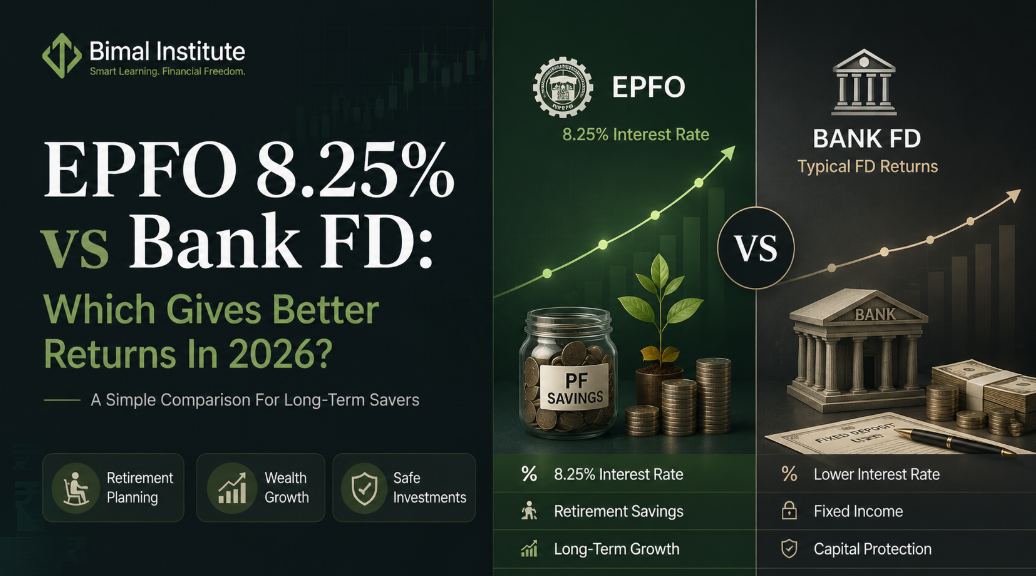
It is the question almost every careful saver in India faces. You have some money set aside, and two safe choices stare back at you. Should you trust your EPF, which quietly pays 8.25%, or should you lock the money in a Fixed Deposit you can see and control? Both feel safe. But “safe” and “smart” are not always the same thing.
This EPF vs FD guide settles the debate for 2026 in plain language, with real numbers, so you can decide where your money should go. We will compare returns, tax, risk, and more, and look at a clear Rs 10 lakh example.
Quick answer: For a salaried person, EPF usually wins. EPF pays 8.25% and is mostly tax-free, while most big-bank FDs pay around 6.5% and are fully taxable. But FDs win in one big area: you can use the money any time. The right pick depends on when you need the cash.
EPFO 8.25% Explained
EPF is your Provident Fund, the money cut from your salary every month and matched by your employer. For 2025-26, the EPFO interest rate is 8.25%, the same as last year, so the rate is stable.

The best part is not just the number. EPF interest is mostly tax-free, it is backed by the government, and it compounds every year. For a salaried person planning for the future, that makes it one of the strongest safe investment options available today.
How Bank FD Returns Work
A Fixed Deposit is simple. You give the bank a lump sum for a fixed time, and the bank pays you a fixed interest rate. Your money is locked, but you can break the FD early if you really need to, usually with a small penalty.

In 2026, fixed deposit returns have come down. Big banks like SBI and HDFC pay roughly 6.25% to 6.6% for general customers, with senior citizens getting about 0.5% more. Some small finance banks offer up to around 8%, but with a different risk feel. The catch is tax: FD interest is fully taxable at your income slab, and the bank cuts TDS once your interest crosses Rs 50,000 in a year.
EPF vs FD: Head-to-Head Comparison
Here is the full picture in one place. This is the heart of the EPF vs FD decision.
| Factor | EPF (8.25%) | Bank FD (approx. 6.5%) |
|---|---|---|
| Returns | 8.25%, higher | Around 6.5% at big banks |
| Tax benefits | Mostly tax-free | Fully taxable at your slab |
| Risk | Very low, government managed | Low, insured up to Rs 5 lakh |
| Government backing | Yes, strong | Indirect, via Rs 5 lakh insurance |
| Liquidity | Low, locked till retirement or set rules | High, can break any time |
| Inflation protection | Better, rate reviewed yearly | Weaker, fixed for the full term |
On returns, tax, and inflation, EPF leads. On liquidity, FD wins clearly. That single trade-off is what your choice comes down to.
Example: Rs 10 Lakh Invested for 10 Years
Numbers make it real. Imagine Rs 10 lakh sitting in each option for 10 years. Here is how they grow.
| Option | Value after 10 years | Tax on returns |
|---|---|---|
| EPF at 8.25% | About Rs 22.1 lakh | Mostly tax-free |
| FD at 6.5% (before tax) | About Rs 18.8 lakh | Fully taxable |
| FD at 6.5% (after 30% tax) | About Rs 15.6 lakh | Already adjusted |
Read that again. The EPF gives you about Rs 22.1 lakh with little or no tax. The same money in an FD gives about Rs 18.8 lakh before tax, and only around Rs 15.6 lakh after tax if you are in the 30% slab. That is a gap of nearly Rs 6.5 lakh, on the same Rs 10 lakh. This is why fixed deposit returns often look better than they really are once tax is counted.

Hidden Advantages of EPF
Beyond the headline rate, EPF carries quiet benefits that FDs simply do not have.
- Forced saving: The money is cut before it reaches your hand, so you save without trying.
- Tax-free compounding: Interest builds on interest, year after year, with little tax drag.
- Employer adds money too: Your employer contributes as well, which an FD never does.
- Pension link: Part of the contribution supports a pension, adding to retirement planning India families rely on.
For long-term goals, these hidden perks make EPF one of the most powerful safe investment options for a salaried Indian.
Situations Where FD Makes More Sense
EPF is not always the answer. FDs have a clear place, and ignoring that would be poor advice.
- You may need the money soon: EPF is locked for the long term. An FD can be broken when an emergency hits.
- You are not a salaried EPF member: Self-employed people, homemakers, and many seniors cannot add to EPF, so an FD is a natural fit.
- Short-term goals: For a goal one or two years away, an FD is the safer match.
- Senior citizens: With higher senior rates and Section 80TTB tax relief, FDs can work well after retirement.
Smart move: Many people do not choose one over the other. They let EPF grow untouched for retirement and keep a separate FD as an emergency fund. EPF vs FD is often “both,” used for different jobs.
Expert Verdict
For a salaried employee building long-term wealth, the EPF vs FD contest is not close. EPF wins on returns, tax, and inflation protection, and the gap grows over time thanks to tax-free compounding. The EPFO interest rate of 8.25% is one of the best risk-free, tax-friendly returns in the country right now.
Bottom line: Use EPF as your core retirement engine and never break it early without a real reason. Use an FD for money you may need soon or as a safe emergency cushion. Let each tool do the job it is best at, and you get the best of both.
FAQs
Is EPF better than FD in 2026?
For a salaried person investing long term, yes. EPF pays 8.25% and is mostly tax-free, while big-bank FDs pay around 6.5% and are fully taxable. FD only wins on liquidity.
What is the EPFO interest rate for 2025-26?
It is 8.25%, kept the same as the previous year and now being credited to subscriber accounts.
Are FD returns taxable?
Yes. Fixed deposit returns are fully taxable at your income slab, and banks deduct TDS once your interest crosses Rs 50,000 in a year.
Is EPF interest fully tax-free?
Mostly. Interest on your own contributions above Rs 2.5 lakh in a year is taxable, but for most salaried people the bulk stays tax-free.
Which is safer, EPF or FD?
Both are among the safest options. EPF is government managed, while bank FDs are insured up to Rs 5 lakh per bank.
Can I withdraw EPF like an FD?
No. EPF is built for retirement and is locked except under set rules. An FD is far more liquid and can be broken with a small penalty.
Should I stop my FD and put everything in EPF?
Not necessarily. Keep an FD for emergencies and short-term needs, and let EPF grow for the long term. Both serve different goals.
Is FD a good choice for senior citizens?
Yes. Senior citizens get higher FD rates and Section 80TTB tax relief, and FDs offer easy access to money, which suits retirement.
Disclaimer: This article is for general information only and is not financial advice. Interest rates, tax rules, and bank offers change often. Figures are approximate and for illustration. Confirm current rates on official EPFO and bank sources or consult a qualified advisor before investing.