

UPI Fees Are Back on the Table: Lok Sabha Amends 2007 Payment Systems Act
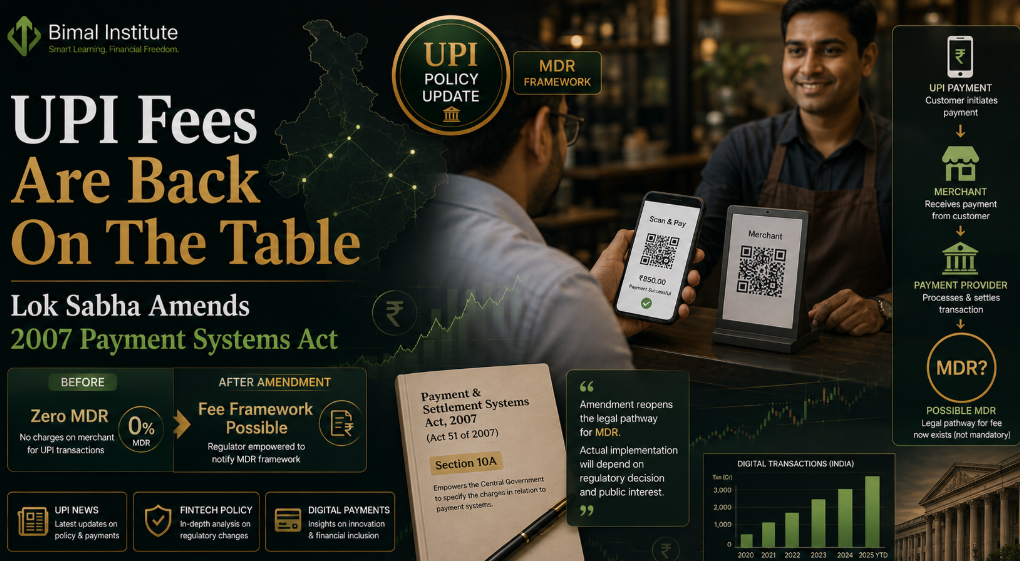
Six years after the government banned merchant charges on UPI, a single amendment in the Lok Sabha has quietly reopened that door. It does not create a fee, but it clears the legal path for one.
Finance Minister Nirmala Sitharaman moved the Taxation and Other Laws (Amendment) Bill, 2026 in the Lok Sabha on 4 August, and the House cleared it by voice vote. It amends Section 10A of the Payment and Settlement Systems Act, 2007, ending the blanket ban on UPI merchant fees.
What the Bill actually changed on 4 August
The Zero-MDR rule from 1 January 2020 was a hard, statutory prohibition. Section 10A said no bank or payment system provider could charge for a payment on notified electronic modes. UPI and RuPay debit cards were the modes in scope.
The new language flips the default. The blanket ban is replaced by an executive framework: the Central Government can notify which electronic modes remain fee-exempt, which categories of user, and which transaction thresholds. Modes not notified may lawfully attract a Merchant Discount Rate, or MDR, the fee a merchant pays a bank or payment service provider to process a digital payment.
The Bill passed without discussion, amid din, when the House resumed at 2 p.m. It also amends the Income Tax Act, 2025 and the Finance Act, 2026. Our note on the ITR filing rules for AY 2026-27 covers the direct-tax side of the same package.
Who pays and who is protected
Sitharaman clarified in the House that consumers will not bear MDR. Small merchants are also expected to remain protected. The fee, if notified, would sit between banks, payment service providers and large merchants at higher thresholds.
Jefferies notes transactions above Rs 2,000 accounted for only 4% of merchant payment volumes in FY26, but around 67% of transaction value. That skew is what makes a threshold-based MDR economically meaningful without touching everyday small payments.
| Aspect | Before 4 August 2026 | After the amendment |
|---|---|---|
| Legal basis | Blanket statutory ban under Section 10A | Executive framework, Central Government notifies |
| Consumer charges | Not permitted | Not permitted, per FM |
| Small merchants | Zero MDR | Protected, per FM |
| Large merchants, high-value payments | Zero MDR | MDR legally possible if notified |
| Modes covered | UPI and RuPay debit | Any electronic mode not exempted by notification |
Why did the government reopen a six-year-old policy?
Scale is the plain answer. NPCI FY26 numbers put UPI at about 241.6 billion transactions worth roughly Rs 314.2 lakh crore, up around 30% by volume year on year. In July 2026 alone, UPI processed a record 23.7 billion transactions. Running that infrastructure without a fee model has been a costly design choice.
The government has been paying part of that cost. It approved Rs 1,500 crore in incentives for low-value BHIM-UPI transactions in the current financial year, following Rs 3,631 crore paid out in FY24. That route is not indefinitely sustainable at UPI’s current scale, and the amendment gives the Centre a second lever.

What Rs 5,000 to 10,000 crore of MDR revenue means
Jefferies estimates a threshold-based MDR could unlock a revenue pool of Rs 5,000 to 10,000 crore for the digital payments industry by FY28, adding roughly $525 million to $1.05 billion to payment platforms’ FY28 revenue. Banks are seen as the largest beneficiaries, followed by Google Pay, PhonePe and Paytm. The recent build in Indian fintech listings, tracked in our note on the Turtlemint fintech IPO, sits inside the same industry re-rating.
The macro backdrop is not neutral. The RBI held the repo rate at 5.25% on 5 August, covered in our piece on the 5 August RBI policy, and Governor Sanjay Malhotra said discussions on UPI MDR are premature at this stage. Even after Parliament clears the amendment, the notification is a separate policy decision, and the RBI’s public position matters. Our note on the diesel export tax move shows how quickly the Centre can act once the legal path is clear.
What did the Payment and Settlement Systems Act amendment do on 4 August 2026?
The Bill amended Section 10A of the Payment and Settlement Systems Act, 2007. It removed the blanket MDR ban on UPI and other electronic modes, and gives the Central Government power to notify which modes stay fee-exempt.
Will consumers pay MDR on UPI transactions?
Finance Minister Sitharaman clarified consumers will not bear MDR. Small merchants are also expected to remain protected. Any charge, if notified, would apply between banks, payment service providers and large merchants.
Which UPI transactions could attract MDR?
The Bill does not fix a threshold. Jefferies has noted transactions above Rs 2,000 form about 4% of merchant payment volumes but 67% of value, making that tier the most-discussed possible cut-off. The actual threshold is set by government notification.
Who benefits if UPI MDR returns?
Banks are seen as the largest beneficiaries, followed by Google Pay, PhonePe and Paytm. Jefferies estimates a revenue pool of Rs 5,000 to 10,000 crore for the digital payments industry by FY28.
When does the amendment take effect?
The Lok Sabha passed the Bill on 6 August 2026 by voice vote. After Rajya Sabha approval and Presidential assent, the amendment becomes law, but MDR does not apply automatically. A separate Central Government notification decides which modes and thresholds attract fees.
View this profile on Instagram
View this profile on Instagram
Read the wider context on the Bill’s introduction on The Hindu’s Parliament coverage and Reuters’ report on how India paved the way for merchant fees on digital payments. To learn how these policy calls shape banking, fintech and taxation together, Bimal Institute’s stock market classes in Indore walk through the mechanics.
This article is for information on the Payment and Settlement Systems Act amendment and is not investment or legal advice. Policy notifications, banking rules and market reactions can move quickly, so verify current details from RBI, the Ministry of Finance and the exchanges, and consult a qualified adviser before acting.