

Fed Rate Hike September 2026: What Warsh’s Decision Means for Markets, Mortgages and India
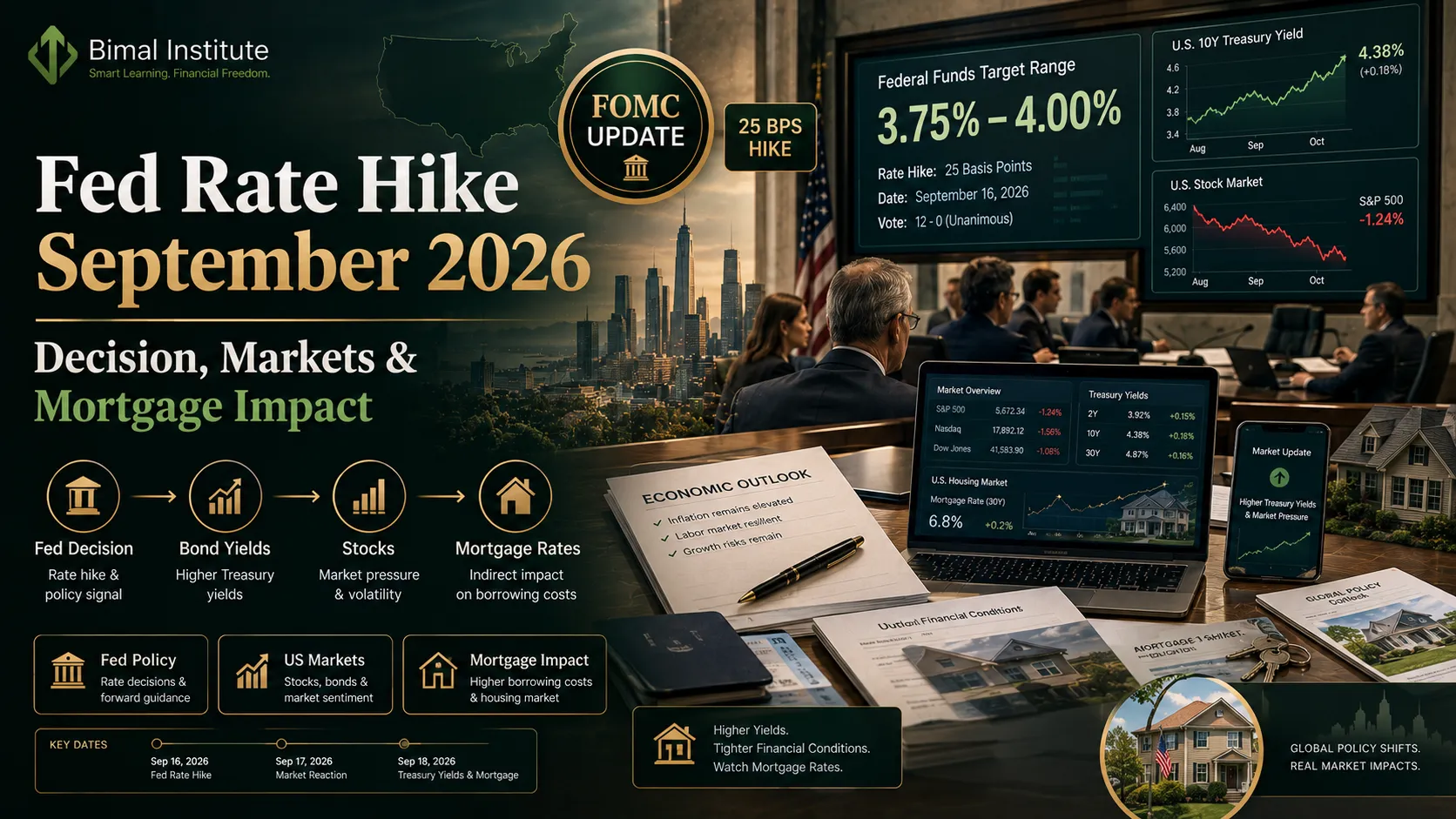
On 16 September 2026 the Federal Reserve raised its benchmark rate by 25 basis points to a target range of 3.75% to 4%, its first hike since 2023. The vote was unanimous at 12-0, and new Chair Kevin Warsh signalled at least one more increase this year. The Dow fell 1.2%, while mortgage rates held near 7%.
Key Highlights
| Detail | Information |
|---|---|
| Decision date | 16 September 2026, 2:00 PM ET |
| Action | Rate hike of 25 basis points (0.25%) |
| New target range | 3.75% to 4.00% |
| Previous range | 3.50% to 3.75% |
| Vote | 12-0, unanimous |
| Fed Chair | Kevin Warsh (17th Chair, since May 2026) |
| Dot plot signal | Median sees one more hike in 2026, ending near 4.1% |
| Core PCE projection (2026) | 3.4% |
| Next FOMC meeting | 27 to 28 October 2026 |
| Dow / S&P 500 / Nasdaq | -1.21% / -0.45% / flat |
| 10-year Treasury yield | Above 5% |
| 30-year mortgage (daily) | Around 7.01% |
What Is the Fed Interest Rate Decision?
Eight times a year, the Federal Open Market Committee, the FOMC, sets the federal funds rate. This is the overnight rate at which US banks lend reserves to each other, and the Fed steers it within a target range. When the range moves, it ripples outward to Treasury yields, business borrowing costs, credit card rates and, indirectly, share prices. A refresher on the committee sits in [INTERNAL LINK: What is the FOMC and how it works].
Four of those eight meetings, including September, also publish a Summary of Economic Projections and the “dot plot,” where each official marks where they expect rates to sit in coming years. That forecast, not just the rate move itself, is what markets scrutinise.
Latest Updates: The 16 September 2026 Decision
The headline is a plot twist. After a run of rate cuts in late 2025 and a long pause through the first half of 2026, the Fed returned to raising rates. Officials lifted the range to 3.75% to 4%, the first increase since July 2023, and the FOMC statement said inflation remained elevated and that the move would support a timelier return to its 2% goal.
Two features made the meeting read hawkish. The vote was unanimous, which the analysts at Emkay Global noted as a signal of institutional resolve behind the new Chair. And the dot plot showed the median official expecting at least one further hike in 2026, taking the rate to roughly 4.1% by year end. Chair Warsh, keeping to his pattern, declined to publish his own rate dot. For context on the numbers driving this, see [INTERNAL LINK: How inflation is measured (CPI vs PCE)].
Why This Matters
A rate decision from the Fed is the closest thing global finance has to a weather system. It sets the price of dollars, and because the dollar underpins world trade and borrowing, the effects travel far beyond America. This particular decision matters more than most because it reverses direction and arrives under a new Chair with a reputation for inflation discipline. Home buyers, savers, equity investors and emerging markets from Mumbai to Sao Paulo all take their cue from it.
Detailed Explanation: The Duration Shock
The sharpest way to understand the market reaction is this. The 25 basis point hike was not the surprise. CME FedWatch had it priced at more than 90% going in. What investors had to reprice was how long rates would stay high. In June, the median official had expected rates to drift down toward 3.6% in 2027. In September, that same median showed no net easing at all next year. The immediate move was a decision the market expected, but the message about persistence was not.
This is why Wall Street turned lower during Chair Warsh’s press conference rather than at 2:00 PM. His restrained, inflation-first tone told traders the tightening bias could last, and long-dated bond yields responded, with the 10-year Treasury pushing above 5% for the first time since the financial crisis era.
Real-Life Examples
Example 1: A US home buyer. Meera is shopping for a first home. The Fed raised its overnight rate, yet her quoted 30-year mortgage barely moved, holding near 7%. That is because mortgages track the 10-year Treasury, not the fed funds rate directly. If the hike convinces bond markets that inflation is being handled, long yields and her mortgage quote could ease even as the Fed’s own rate sits higher.
Example 2: A saver. Ravi keeps cash in a high-yield savings account. A higher policy rate tends to lift deposit and certificate rates, so his idle cash may earn a little more. The catch, as the strategists at Chase have pointed out, is that money in cash can still lose value in real terms if it earns less than inflation after tax.
Example 3: An Indian IT investor. Anjali holds Indian technology shares. On 17 September, Nifty IT slipped around 0.5% because persistently high US borrowing costs can slow the discretionary tech spending of American clients. The Fed she cannot vote for still moves the earnings outlook of the companies she owns. More on this in [INTERNAL LINK: How US Fed decisions affect Indian markets].
Calculations Section
Numbers make the transmission concrete. First, the rate arithmetic. The new range of 3.75% to 4% has a midpoint of 3.875%. The Fed’s own median projection of 4.1% for end 2026 implies roughly one more 25 basis point step, since 4.1% minus 3.875% is about 0.225%. That is an inference from the dot plot, not a promise.
Second, the mortgage math. The table below shows the monthly principal and interest on a $400,000, 30-year loan at different rates, illustrating why even small rate moves matter over decades.
| 30-year rate | Monthly payment | Total interest over 30 years |
|---|---|---|
| 6.00% | About $2,398 | About $463,000 |
| 6.76% | About $2,597 | About $535,000 |
| 7.00% | About $2,661 | About $558,000 |
| 7.25% | About $2,729 | About $582,000 |
Third, the real policy rate. With the range midpoint at 3.875% and core PCE inflation near 3.3%, the Fed is running a positive real rate of roughly half a percentage point. That is restrictive but not extreme by historical standards, which helps explain why officials feel they have room to hold rates high rather than reverse quickly. A grounding in yields helps here: see [INTERNAL LINK: Understanding bond yields and interest rates].
Expert Analysis
Here is the contrarian read. Almost every search around this event assumes a rate cut, and President Trump appointed Kevin Warsh in the expectation of lower rates. Instead, the market got the opposite. Faced with oil above $100 a barrel from the US and Iran conflict, producer prices that jumped earlier in the year, and core inflation stuck above target, the new Chair delivered a hike and signalled more. That gap between the political wish for cuts and the arithmetic of inflation is the real story of 2026.
My second observation cuts against a common belief. Many assume the Fed sets mortgage rates. It does not. In 2025, when the Fed was cutting, mortgage rates actually rose, because the bond market was pricing future inflation. A credible hike now can, paradoxically, cool long-term yields and take pressure off mortgages. The Fed’s short rate and the borrowing costs households actually pay can move in opposite directions, and this cycle is a live demonstration.
Who Benefits From a Rate Hike
Higher rates are not bad news for everyone. Savers, retirees living on fixed deposits, and holders of new short-term Treasuries tend to earn more. A firmer dollar can lower the cost of imports for US buyers. And for anyone worried about the erosion of purchasing power, a central bank willing to prioritise price stability is doing the one job that protects the value of money over time.
Risks and Limitations
The flip side is real. Higher borrowing costs squeeze mortgage and credit card holders, raise the cost of company debt, and can slow hiring and investment. For emerging markets, richer yields on safe US assets can pull capital away, pressure local currencies and tighten financial conditions abroad. And a central bank that keeps rates restrictive for too long risks tipping growth lower than intended. History shows equity markets often wobble in the weeks right after a hike, though such moves have frequently been short-lived. None of that is a forecast, only a reminder that policy works with a lag.
Comparison Table: Hike vs Hold vs Cut
| Factor | Rate Hike (current) | Rate Hold | Rate Cut |
|---|---|---|---|
| Main goal | Cool inflation | Wait and assess | Support growth |
| Borrowers | Costs rise | Costs steady | Costs ease |
| Savers | Yields rise | Yields steady | Yields fall |
| US dollar | Tends to strengthen | Neutral | Tends to soften |
| Emerging markets | Outflow pressure | Neutral | Inflow support |
| Typical trigger | Rising inflation | Mixed data | Slowing economy |
Comparison Table: This Move vs the 2022-23 Cycle
| Feature | 2022-23 hikes | September 2026 hike |
|---|---|---|
| Step size | Often 50 to 75 bps | 25 bps |
| Fed Chair | Jerome Powell | Kevin Warsh |
| Main driver | Broad post-pandemic inflation | Energy-led inflation, oil above $100 |
| Market surprise | Pace of hikes | How long rates stay high |
What It Means Beyond the US: India and Emerging Markets
For Indian markets, the reaction on 17 September was measured because the hike was expected. The Sensex traded modestly higher near 74,600 and the Nifty hovered around 23,200 to 23,400, with financials, autos and public sector banks supporting the index while IT lagged. Beneath the calm, three pressures are building: the rupee weakened past 96 to the dollar, Brent crude stayed elevated near $105, and foreign institutional investors remained net sellers. For an oil importer, a weak rupee and costly crude together strain inflation and the trade balance. The takeaway from strategists such as those at Geojit was that the market had already discounted the move. To follow the currency angle, see [INTERNAL LINK: What is the rupee-dollar exchange rate].
Future Outlook
The next decision lands on 28 October 2026. By the Fed’s own projections, the tightening bias has not ended, and officials have tied the path closely to energy prices. If oil eases and inflation cools, the case for holding steady strengthens. If crude stays high, the door to another hike remains open. These are the Fed’s stated expectations and market-implied odds, not certainties, and the data between now and late October will shape them.
Action Steps
Read the primary sources before reacting to headlines. The FOMC statement, the dot plot and the meeting calendar are all published on the Federal Reserve site. If you carry a mortgage or plan to borrow, track the 10-year Treasury yield, since that drives loan pricing more than the Fed’s overnight rate. If you invest across borders, watch the dollar, oil and foreign flows together rather than in isolation. And treat rate decisions as context for your own long-term plan, not as a trigger to trade. For anything specific to your finances, consult a registered financial adviser.
Frequently Asked Questions
What did the Fed decide on 16 September 2026?
It raised the federal funds rate by 25 basis points to a target range of 3.75% to 4%, its first hike since 2023, in a unanimous 12-0 vote.
Did the Fed cut or hike rates?
It hiked. Despite widespread expectations of cuts earlier in the cycle, the Fed raised rates to counter elevated, energy-led inflation.
Who is the current Fed Chair?
Kevin Warsh, confirmed by the Senate in May 2026 as the 17th Chair, succeeding Jerome Powell. Powell remains on the Board as a Governor.
Why did the stock market fall after the hike?
The hike itself was expected. Markets dropped because the dot plot and Chair Warsh’s tone signalled that high rates may last longer than previously thought.
What is the current fed funds rate?
The target range is 3.75% to 4%, with a midpoint of 3.875%, as of the 16 September 2026 decision.
When is the next FOMC meeting?
The next meeting is 27 to 28 October 2026, with the rate decision due on 28 October at 2:00 PM ET.
How does a Fed rate hike affect mortgage rates?
Not directly. Mortgage rates track the 10-year Treasury yield, which moves on inflation expectations. Rates can rise or fall independently of the Fed’s overnight rate.
What are mortgage rates today?
The daily 30-year fixed rate sat around 7.01%, with the 15-year near 6.39%, a one-year high, according to market trackers and Freddie Mac’s weekly survey near 6.76%.
What is the Fed dot plot?
It is a chart summarising where each FOMC official expects the policy rate to be in future years. The September plot pointed to one more hike in 2026.
How does the Fed decision affect India?
A higher US rate can strengthen the dollar, pressure the rupee and encourage foreign investors to move money toward safer US assets, which can weigh on Indian equities.
Why did Trump want cuts but the Fed hiked?
The President has pushed for lower rates, but the Fed sets policy on inflation data. With inflation elevated, the committee judged a hike necessary despite political pressure.
Will the Fed raise rates again in 2026?
The Fed’s own median projection implies roughly one more increase this year, but the path depends on incoming inflation and oil data. It is a projection, not a commitment.
People Also Ask
- What time is the Fed rate decision announced?
- Is the Fed done raising rates?
- What is the difference between the fed funds rate and mortgage rates?
- How high is the 10-year Treasury yield now?
- What does a stronger dollar mean for gold?
- How does the Fed decision affect the Nifty and Sensex?
Final Verdict
The September 2026 decision reset the narrative. A new Chair, a first hike in three years, and a dot plot pointing to more, all driven by inflation that refuses to fall while oil stays high. For markets, the shock was about duration, not the move itself. For households, the practical signal is that borrowing stays expensive and cash finally earns something. For investors outside the US, the dollar and oil now matter as much as any local factor. What you do with that depends on your own goals and time horizon, not on the headline.
Sources and Further Reading
- Federal Reserve, monetary policy and FOMC statements: federalreserve.gov
- Freddie Mac Primary Mortgage Market Survey: freddiemac.com
- U.S. Bureau of Labor Statistics (inflation data): bls.gov
- U.S. Bureau of Economic Analysis (PCE data): bea.gov
- Reserve Bank of India: rbi.org.in
Disclaimer: This article is for educational purposes only. It is not investment, financial, tax or legal advice, nor a recommendation to buy, sell or hold any security, currency or asset. Interest rates, market levels and mortgage rates change constantly and figures reflect the dates cited. Investing and borrowing involve risk, including loss of capital. Please verify current data with official sources and consult a registered financial adviser before making any decision. Bimal Institute is a trading and finance education institute and does not provide buy or sell recommendations.