

Hang Seng Index Rebounds to 24,213 After a 10.73% First-Half Fall
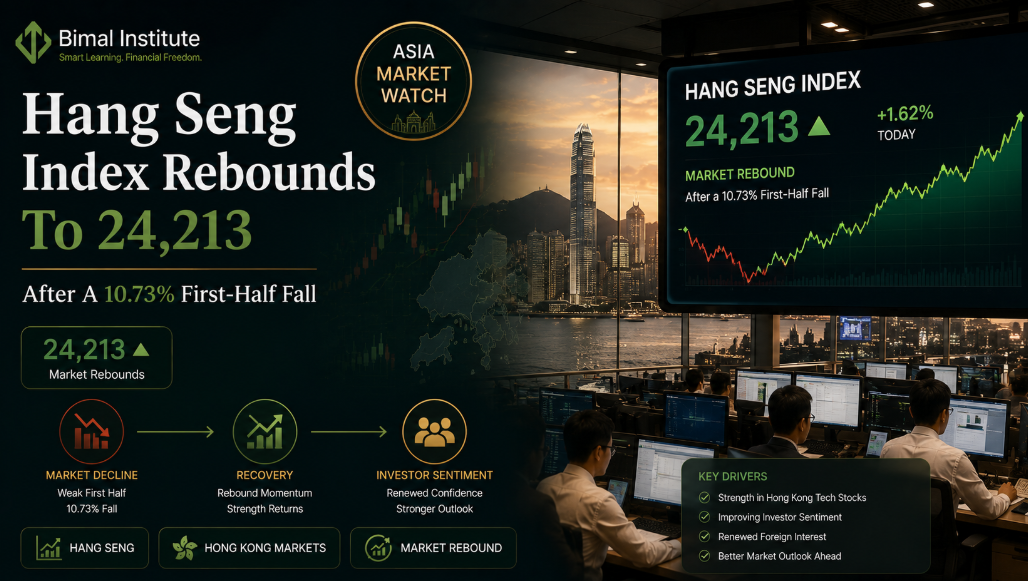
Hong Kong’s benchmark spent the first six months of 2026 losing ground, then turned in July. The Hang Seng Index has quietly become one of the most watched charts in Asia again, and a small slice of Indian money rides on it.
Quick answer: The Hang Seng Index closed at 24,213.72 on Monday, 13 July 2026, up 38.60 points or 0.16%. That comes after a bruising first half, in which the index ended June at 22,881.02, down 10.73% for the calendar year.
A Market That Fell Hard, Then Found a Bid
The rebound is the story. From the 30 June close of 22,881.02 to Monday’s 24,213.72, the Hang Seng Index has recovered roughly 5.8% in about two weeks.
Monday’s session was not a broad rally. The Hang Seng TECH Index slipped about 1% to 4,676, while the Hang Seng China Enterprises Index rose 0.3% to 8,065, and that split kept the headline benchmark just above water.
Turnover told the real story: HK$309.51 billion changed hands, a heavy number for a day the index moved less than a tenth of a percent. Plenty of buying, plenty of selling, very little net movement.
The index has swung between 22,518.00 and 28,056.10 over the past 52 weeks. That range, nearly a quarter of the index level, is the single most useful number for anyone thinking about Hong Kong exposure.
What Exactly Is the Hang Seng Index?
It is Hong Kong’s benchmark, the local equivalent of the Nifty 50. It was launched on 24 November 1969 with a base value of 100 set to 31 July 1964, which makes it one of Asia’s oldest live indices.
According to the Hang Seng Indexes factsheet for June 2026, the index now holds 93 constituents and covers 64.08% of the market value of the Hong Kong exchange’s main board. No single stock can exceed an 8% weight, a cap designed to stop one giant from dominating the gauge.
The top of the index is a mix of a British bank, two Chinese internet giants and a state-owned lender:
- HSBC Holdings, 9.15%
- Tencent, 8.13%
- Alibaba, 6.46%
- China Construction Bank, 5.19%
- AIA, 5.02%
That mix explains the volatility. When Chinese technology sentiment turns, the Hang Seng turns with it, in a way the Sensex and Nifty rarely do.
Cheap on Paper, and That Is the Whole Debate
The same official factsheet puts the index price-to-earnings ratio at 12.68 and the dividend yield at 3.27% as on 30 June 2026. The Nifty 50 has spent most of the last two years trading at roughly twice that earnings multiple.
A low P/E means investors are paying less for each rupee of company profit. It is not automatically a bargain, because the market is also pricing in regulatory risk, geopolitics and slower Chinese growth.
Hong Kong’s other engine right now is issuance. The city’s IPO market has raised close to $44 billion in the first half of 2026, its strongest opening six months in five years, which keeps global money circling the exchange even when the index goes nowhere.
Why a Hong Kong Index Shows Up in an Indian Demat Account
You do not need an overseas broker to track it. Nippon India ETF Hang Seng BeES, listed on the NSE under the symbol HNGSNGBEES, has been running since 9 March 2010 and holds the index stocks in the same proportion.
One unit is designed to be worth roughly one-thousandth of the Hang Seng Index, so a single unit costs a few hundred rupees. That puts it well inside the range most people already have when they start out with a small trading account.
Two things Indian buyers routinely miss. First, the currency: your return is the index return adjusted for how the Hong Kong dollar moves against the rupee, which is why currency correlation matters as much as the chart. Second, ETF units can trade away from their true value when volumes are thin, so the bid-ask spread is a real cost.
How Does It Compare With the Nifty 50?
This is the table that settles most arguments. The figures are from the fund’s own April 2026 product note, calculated as on 30 April 2026 and stated in rupee terms.
| Period | Hang Seng TRI | Nifty 50 TRI |
|---|---|---|
| 1 year | 33.33% | -0.28% |
| 3 years (annualised) | 18.99% | 11.18% |
| 5 years (annualised) | 6.19% | 11.69% |
| Since 9 March 2010 (annualised) | 9.47% | 11.39% |
Read it carefully. Hong Kong beat India comfortably over one year and three years, and lost to it over five years and over the full 16-year stretch.
That is what a volatile, cyclical market looks like from the outside. It rewards patience in bursts and punishes it in between, which is the opposite of the steady compounding Indian investors have grown used to in domestic equity.
What to Watch Next
The near-term driver is not Hong Kong at all. It is oil, the US-Iran standoff and the direction of global chip stocks, the same forces that dragged the Hang Seng TECH Index lower on Monday even as the broader index held.
For an Indian investor, the honest use of the Hang Seng is as a diversifier, a market whose ups and downs do not line up neatly with the Nifty. The next set of Chinese inflation and trade prints will do more to move it than anything happening in Mumbai.
Frequently Asked Questions
What is the Hang Seng Index?
It is Hong Kong’s benchmark stock index, launched on 24 November 1969 and maintained by Hang Seng Indexes Company. As of 30 June 2026 it holds 93 constituents and covers 64.08% of the main board’s market value.
Where did the Hang Seng close on 13 July 2026?
It closed at 24,213.72, up 38.60 points or 0.16%, on turnover of HK$309.51 billion.
Can Indians invest in the Hang Seng Index?
Yes. Nippon India ETF Hang Seng BeES trades on the NSE under the symbol HNGSNGBEES and tracks the index. It can be bought in units of one through a normal Indian demat account.
How has the Hang Seng done against the Nifty 50?
Over one year to 30 April 2026, the Hang Seng TRI returned 33.33% in rupee terms against -0.28% for the Nifty 50 TRI. Over five years the Nifty was ahead, at 11.69% annualised versus 6.19%.
What is the Hang Seng TECH Index?
It is a separate gauge of Hong Kong’s largest technology-linked listings, including names like Tencent, Xiaomi and Meituan. It closed at 4,676 on 13 July 2026, down about 1%.
How are gains from a Hang Seng ETF taxed in India?
Overseas equity ETFs do not get the same treatment as domestic equity funds, so the holding period and slab rules differ. The rules are set out in this guide to how trading and investment profits are taxed in India, and remittance limits sit under the RBI’s FEMA rules.
View this profile on Instagram
View this profile on Instagram
If you want to learn how global indices, currencies and index funds actually connect before you put money on one, start with Bimal Institute’s free trading course.
Note: Global equity indices are volatile and prices can fall as easily as they rise, and currency movement can add or subtract from returns for an Indian investor. This article is for information and education only, is not investment advice, and carries no buy or sell calls, target prices or predictions. Past performance does not indicate future returns.