

Gold and Silver Prices in India 2026: Rates, Trends, Calculations & Expert Analysis
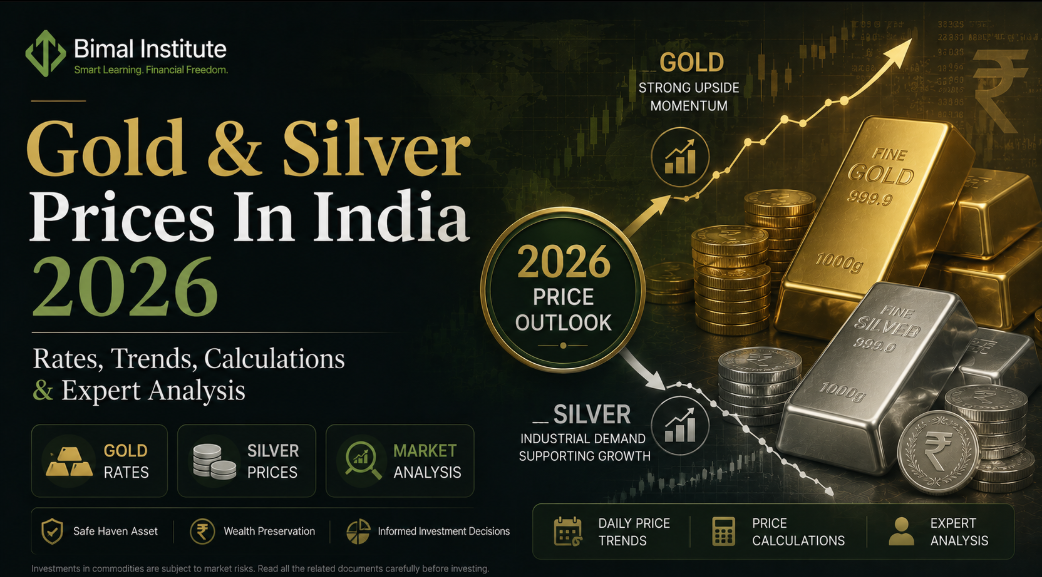
As of late June 2026, 24K gold is about Rs 1,44,500 per 10 grams, 22K gold about Rs 1,32,500, and silver roughly Rs 2,35,000 to Rs 2,45,000 per kg. Both metals have slid from early-2026 record highs as a hawkish US Federal Reserve and a stronger dollar pressured bullion. Prices change daily.
Key Highlights
Here is a quick snapshot of where gold and silver prices stand in India right now, before we dig into what is driving them.
| Metal / Item | Rate (late June 2026) |
|---|---|
| 24K Gold (per 10 g) | About Rs 1,44,500 |
| 22K Gold (per 10 g) | About Rs 1,32,500 |
| 18K Gold (per 10 g) | About Rs 1,08,500 |
| Silver (per kg) | About Rs 2,35,000 to Rs 2,45,000 |
| USD / INR | About Rs 94.4 |
| 2026 record gold high | Around Rs 1,79,000 per 10 g (January 2026) |

What Are Gold and Silver Prices?
Gold and silver prices are the rates at which these precious metals trade, quoted in India per 10 grams for gold and per kilogram for silver. They are not set by any single shop. Indian rates are derived from international spot prices set in London and on COMEX, converted into rupees using the USD-INR rate, and then adjusted for import duty and a 3% GST. The India Bullion and Jewellers Association (IBJA) publishes the benchmark rates that most jewellers follow.
View this profile on Instagram
Latest Updates: A Record High, Then a Sharp Fall
The big story of 2026 is volatility. Gold raced to an all-time high of around Rs 1,79,000 per 10 grams in January 2026, then drifted down to about Rs 1,44,500 by late June, a fall of nearly a fifth from the peak. Silver was even wilder: it spiked above 100 dollars an ounce globally in late January, then crashed through February and March after the CME sharply raised futures margin requirements, forcing leveraged traders to sell.
The most recent leg lower, in the third week of June 2026, came from a hawkish Fed stance and a firmer dollar. According to reporting around MCX and IBJA data, both metals fell together, with silver dropping more sharply, as it usually does. To understand why central bank signals move metals, see this guide on how the FOMC statement works and how central banks influence global markets.
| Month (2026) | 24K Gold (per 10 g, approx.) |
|---|---|
| December 2025 (close) | Rs 1,36,470 |
| January 2026 (peak) | Rs 1,79,140 (record high) |
| March 2026 (close) | Rs 1,48,420 |
| May 2026 (close) | Rs 1,57,190 |
| Late June 2026 | Rs 1,44,500 |
Why This Matters
For Indian households, gold is not just an investment, it is jewellery, a wedding essential, and a store of family wealth. A 20% swing in price changes the cost of a wedding purchase by lakhs. For investors, gold and silver are hedges against inflation and currency weakness. So these prices touch nearly everyone, from a bride’s family in a small town to a fund manager in Mumbai.
View this profile on Instagram
Detailed Explanation: What Moves the Prices
Several forces decide gold and silver prices on any given day. Knowing them helps you read the market instead of guessing.
- International spot price: The London and COMEX rate is the global anchor.
- Rupee-dollar rate: A weaker rupee makes imported metal costlier, even if global prices are flat. This is why the currency correlation matters.
- US Fed and interest rates: Higher rates and a strong dollar usually pull gold down, since gold pays no interest.
- Inflation and safe-haven demand: Gold tends to rise when inflation or geopolitical fear climbs.
- Central bank buying: The RBI and other central banks have been adding gold reserves, supporting long-term demand.
- Silver’s industrial side: Silver also tracks demand from solar panels, EVs, and electronics, making it more volatile.

Real-Life Examples
Example 1: The wedding buyer
A family in Indore buying 50 grams of 22K gold for a wedding would have paid about Rs 8.95 lakh at the January peak, but only about Rs 6.63 lakh in late June. The same jewellery, over Rs 2.3 lakh cheaper, just months apart.
Example 2: The peak-buyer’s regret
An investor who bought 10 grams of 24K gold at the January high of about Rs 1,79,140 was sitting on a roughly 19% paper loss by late June. Timing, not just choosing gold, decided the outcome.
Example 3: The patient holder
Someone who bought 10 grams in December 2025 at about Rs 1,30,090 was still up about 11% by late June 2026, despite the crash. Holding through volatility worked better than chasing the top.
| When Bought | Price (10 g, 24K) | Value Late June 2026 | Return |
|---|---|---|---|
| December 2025 | Rs 1,30,090 | Rs 1,44,470 | About +11% |
| January 2026 (peak) | Rs 1,79,140 | Rs 1,44,470 | About -19% |
| Late June 2026 | Rs 1,44,470 | Rs 1,44,470 | Entry point |
Calculations Section
Calculation 1: Real cost of gold jewellery.
10 g of 22K gold at Rs 13,254/g = Rs 1,32,540 (metal value).
Add making charges at 12% = Rs 15,905.
Subtotal = Rs 1,48,445. Add 3% GST = Rs 4,453.
Final bill = about Rs 1,52,898. Note how making charges and GST add nearly Rs 20,000 over the metal value.
Calculation 2: The gold-silver ratio.
Gold at Rs 14,459/g divided by silver at Rs 245/g = about 59. So it takes roughly 59 grams of silver to buy 1 gram of gold. Analysts watch this ratio because a high number is often read as silver being cheap relative to gold.
Calculation 3: Silver in everyday units.
Silver at Rs 2,45,000 per kg works out to Rs 2,450 per 10 grams and Rs 245 per gram. A 1 kg silver coin therefore costs roughly the same as about 1.7 grams of 24K gold.
Expert Analysis
Here is a view you will not find in a typical price-update blog. The 2026 crash was not a failure of gold and silver, it was a flush-out of speculation. When silver shot above 100 dollars, much of the move was leveraged futures buying, not real demand. Once the CME raised margins, that money fled, and prices fell harder than fundamentals alone justified. The underlying story, central bank gold buying and a structural silver supply deficit, did not break. That is the difference between price and value, and it is the single most useful lens for reading bullion.
A contrarian point: many Indians buy gold at the top, during the festive and wedding rush, and go quiet when prices fall. The late-June dip is exactly the kind of moment disciplined buyers prefer, though that is an observation about behaviour, not a recommendation to act. Some investors also weigh the safe-haven role of gold against newer assets, which is part of why some argue bitcoin strengthens as a parallel hedge.
Benefits
- Inflation hedge: Gold has historically held value when the rupee weakens.
- Liquidity: Both metals are easy to sell almost anywhere in India.
- Diversification: They often move differently from stocks.
- Silver’s growth angle: Industrial demand from solar and EVs adds a structural tailwind.
Risks and Limitations
- High volatility: A 19% fall in months shows the downside risk.
- No income: Physical metal earns nothing while you hold it.
- Costs: Import duty and GST add roughly 14% to 15% before any price gain helps you, and jewellery making charges add more.
- Storage and purity: Physical gold carries theft and purity concerns.
Comparison Table: Ways to Own Gold and Silver
Physical metal is not the only route. This table compares the main options Indian investors use.
| Option | Key Feature | Watch-out |
|---|---|---|
| Physical gold/silver | Tangible, usable as jewellery | Making charges, storage, purity |
| Sovereign Gold Bond (SGB) | About 2.5% interest plus price gain, no making charge | Long lock-in, issued by RBI in windows |
| Gold/Silver ETF | Trades on exchange, easy liquidity | Needs a demat account, small fees |
| Digital gold | Buy from as little as Rs 100 | Platform and spread costs |
Future Outlook
Analysts are split, which is healthy. On silver, some project a recovery toward 95 to 106 dollars an ounce by the end of 2026, citing a sixth straight year of global supply deficit and strong industrial demand. The bear case sees silver testing 60 to 65 dollars if the dollar stays strong and the Fed delays rate cuts. Gold’s path is tied closely to the Fed, the rupee, and central bank buying. These are projections from market analysts, not certainties, and this article makes no price prediction of its own.
Action Steps: What To Do Next
- Check the benchmark: Compare any jeweller’s quote with the IBJA rate for the day.
- Always demand a bill: Ask for a clear breakup of metal value, making charges, and GST.
- Insist on hallmarking: Buy only BIS-hallmarked gold for guaranteed purity.
- Match the product to the goal: For pure investment, SGBs and ETFs avoid making charges; for jewellery, accept that those charges apply.
- Think in years, not days: The 2026 swings show why long horizons suit metals better than short bets.
FAQs
What is the gold rate today in India?
In late June 2026, 24K gold is about Rs 1,44,500 per 10 grams and 22K about Rs 1,32,500, though rates change daily.
What is the silver price today in India?
Silver is around Rs 2,35,000 to Rs 2,45,000 per kg in the physical market, with MCX futures often a little higher.
Why are gold and silver prices falling in 2026?
A hawkish US Federal Reserve and a stronger dollar have pressured both metals, after record highs earlier in the year.
Why did silver crash in early 2026?
After spiking above 100 dollars an ounce, the CME raised margin requirements, forcing leveraged traders to sell, which deepened the fall.
What is the gold-silver ratio now?
It is roughly 59, meaning about 59 grams of silver equal the price of 1 gram of gold.
How is gold jewellery price calculated?
Metal value (weight times rate) plus making charges plus 3% GST. Making charges and GST can add close to Rs 20,000 on a 10-gram piece.
Is 22K or 24K gold better?
24K (99.9%) is purest and best for investment; 22K (91.6%) is stronger and used for jewellery.
What are the charges over the metal price?
Import duty and GST add roughly 14% to 15%, and jewellery making charges add more on top.
Is a Sovereign Gold Bond better than physical gold?
For pure investment, SGBs add about 2.5% interest, have no making charge, and offer tax benefits on maturity, but they have a long lock-in.
Is silver a good investment in 2026?
Silver offers industrial growth potential but is more volatile than gold. Views differ, so it suits those who can handle big swings.
How are Indian gold prices set?
From international spot prices, converted to rupees, adjusted for import duty and GST, with IBJA publishing the benchmark.
Where can I track reliable rates?
Use IBJA benchmark rates, MCX for futures, and the RBI and World Gold Council for official data and reports.
Final Verdict
Gold and silver prices in 2026 have delivered a vivid lesson: record highs and sharp falls in the same year. The metals remain core to Indian savings and a real hedge against inflation and a weak rupee, but they are not one-way bets. The smart approach is to separate price from value, buy with a long horizon, watch the IBJA benchmark, and choose the right format for your goal. This article is for information and education only and is not financial advice.
Authority references:
1. India Bullion and Jewellers Association (IBJA): ibja.co (benchmark rates)
2. Reserve Bank of India (gold reserves, Sovereign Gold Bonds): rbi.org.in
3. Multi Commodity Exchange (MCX) for futures: mcxindia.com
4. World Gold Council (demand and trend data): gold.org