

WhatsApp’s New Boss: Kunal Shah and the Meta-CRED $900 Million Deal Explained
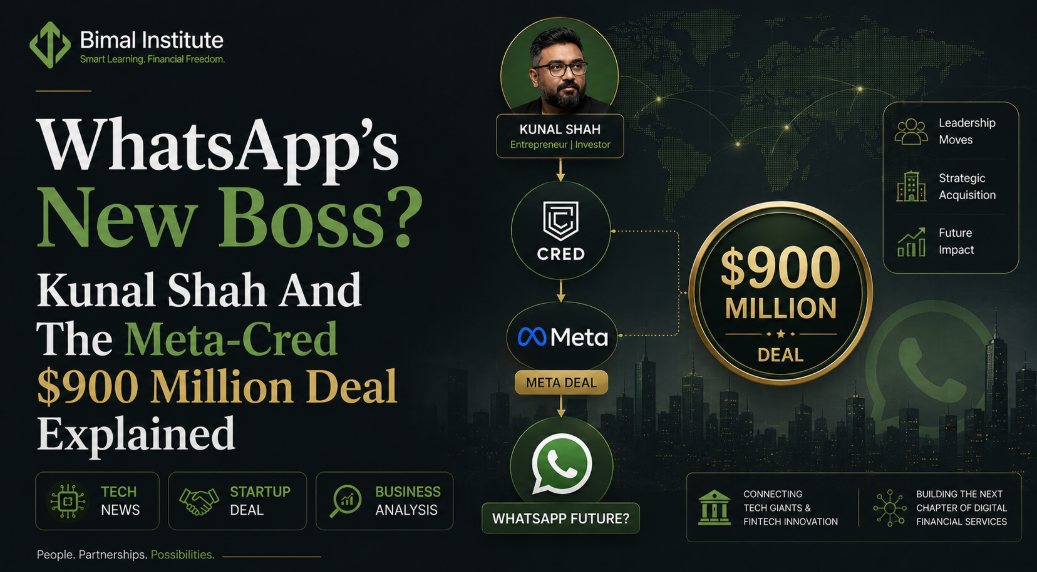
On 22 June 2026, Meta named CRED founder Kunal Shah as WhatsApp’s new global head, the first Indian to lead the 3-billion-user app, replacing Will Cathcart. The move came bundled with Meta’s roughly 900 million dollar investment in CRED for about a 20% stake, valuing the fintech at 4.5 billion dollars. It signals Meta’s big payments push in India.
Key Highlights
Before the analysis, here is the deal in one glance.
| Item | Detail |
|---|---|
| New WhatsApp head | Kunal Shah (CRED founder) |
| Replaces | Will Cathcart (after nearly 7 years) |
| Meta investment in CRED | About 900 million dollars |
| Stake | Roughly 20% (minority) |
| CRED valuation | About 4.5 billion dollars (around Rs 43,000 crore) |
| Data access for Meta | No access to CRED member data |
| CRED interim CEO | Miten Sampat |
What Is the Meta-CRED-WhatsApp Deal?
This is two linked events in one announcement. First, a leadership change: Kunal Shah, who built the Indian fintech CRED, will lead WhatsApp globally. Second, a financing round: Meta is putting roughly 900 million dollars into CRED through a mix of primary and secondary shares, taking a minority stake. Importantly, Meta is not buying CRED, and it does not get access to CRED’s customer data. Shah steps back as CRED CEO but keeps his shareholding.

Latest Updates
The announcement landed on 22 June 2026 and was confirmed by outgoing WhatsApp head Will Cathcart, who will stay on at Meta to build new products during the transition. CRED separately said it raised the new capital at a 4.5 billion dollar post-money valuation, with Miten Sampat, its strategy and finance head, taking over as interim CEO. Reports also noted CRED recently secured payment aggregator approval and is preparing for an eventual IPO.
The timing matters. India recently pushed its planned 30% market-share cap for UPI apps to the end of December 2026, and the NPCI removed onboarding limits for WhatsApp Pay, giving Meta more room to grow its payments service.
View this profile on Instagram
Why This Matters
India is WhatsApp’s largest market, with more than 500 million of its 3 billion-plus global users. Yet WhatsApp Pay has never matched the scale of PhonePe or Google Pay. By bringing in a respected fintech founder and taking a stake in CRED, Meta is signalling that payments, commerce, and financial services inside WhatsApp are now a top priority. For India’s digital economy, a deeper push by a platform this large is a significant development.
CRED and WhatsApp by the Numbers
A few figures explain why this deal is being watched so closely.
| Metric | Figure |
|---|---|
| WhatsApp global users | Over 3 billion |
| WhatsApp users in India | Over 500 million (largest market) |
| CRED members | About 17 million |
| India card-bill payments via CRED | More than 40% |
| CRED lending book (AUM) | Over Rs 24,000 crore |
| CRED annual revenue | About 325 million dollars (around Rs 3,070 crore) |
Detailed Explanation: The Strategy Behind the Move
The structure is the clever part. Rather than acquiring CRED outright, which would invite heavy regulatory scrutiny in India over data and foreign ownership, Meta chose a minority investment plus a founder hire. That gives it strategic proximity and operating knowledge without taking control of CRED’s data or governance.
What Meta really gains is Shah’s experience in India’s regulated, trust-driven fintech market. CRED built its brand on rewarding credit-card discipline and premium engagement, not raw transaction volume. That mindset could reshape how payments, credit, and commerce sit inside chat. The vision being discussed is a single flow: a user spots a product on Instagram, chats with a WhatsApp business bot, pays in-app, and the merchant gets paid, with Meta earning on the flow.
View this profile on Instagram
Real-Life Examples
Example 1: The shopping flow Meta wants
Imagine seeing a sofa ad on Instagram, messaging the seller on WhatsApp, asking questions to an AI bot, and paying right there without leaving the chat. That seamless ad-to-payment loop is exactly what Meta is chasing, and CRED-style execution is meant to enable it.

Example 2: CRED’s own journey
Shah launched CRED in 2018 with about 1 million dollars of his own money. By 2026 it had grown to 17 million members, handled over 40% of India’s credit-card bill payments, built a lending book above Rs 24,000 crore, and reported its first profitable quarter. That track record is what Meta is buying into.
Example 3: The Big Tech playbook
This deal mirrors a wider pattern. Instead of full takeovers that trigger antitrust and data concerns, large tech firms increasingly take minority stakes and recruit founders to gain influence. In India’s data-localisation climate, that approach is especially practical.
Calculations Section
Calculation 1: Implied valuation.
If 900 million dollars buys about a 20% stake, the implied value is 900 / 0.20 = 4.5 billion dollars. The math matches the reported 4.5 billion dollar post-money valuation.
Calculation 2: Valuation in rupees.
At about Rs 94.4 to the dollar, 4.5 billion dollars equals roughly Rs 42,500 crore. Indian reports put it near Rs 43,239 crore, in the same range.
Calculation 3: India’s weight for WhatsApp.
With 500 million Indian users out of 3 billion globally, India accounts for about 16.7% of WhatsApp’s user base, its single largest market and the natural place to test payments.
Expert Analysis
Here is the insight most headlines miss: this is not really a 900 million dollar bet on CRED. It is a talent acquisition wrapped in a financing round. Meta has had WhatsApp’s enormous Indian reach for years and still could not crack payments, because reach alone never was the bottleneck. The missing pieces were merchant acceptance, trust, and regulatory fluency, all areas where an operator like Shah has lived experience.
A contrarian note worth stating plainly: the deal also carries clear execution risk. WhatsApp Pay has underperformed for years, and a single leader, however capable, cannot instantly fix distribution and merchant networks. Investors should treat this as the start of a long campaign, not a finished win. Like decentralised systems explained in this guide on DeFi for beginners, the promise of embedded finance is huge, but real-world adoption is slow and hard-won.
Benefits
- For Meta: Fintech leadership and a strategic stake in India’s payments race.
- For CRED: Fresh capital, a marquee global investor, and momentum toward an IPO.
- For users: Potentially smoother in-chat shopping and payments over time.
- For India’s startup scene: A high-profile vote of confidence in homegrown fintech talent.
Risks and Limitations
- Execution risk: WhatsApp Pay still trails PhonePe and Google Pay by a wide margin.
- Regulatory watch: UPI market-share rules and data norms could shift after December 2026.
- Integration challenge: Merging a founder-led fintech culture into a global platform is hard.
- Trust and data debate: Any Meta involvement in finance draws scrutiny, even without data access.
Comparison Table: How WhatsApp Pay Stacks Up
To see the size of the task, here is how WhatsApp Pay compares with India’s UPI leaders.
| Player | Position in India | Edge |
|---|---|---|
| PhonePe | UPI market leader | Huge merchant network |
| Google Pay | Strong number two | Wide user trust |
| WhatsApp Pay | Small share, huge user base | 3 billion-user chat reach |
| CRED | Premium, credit-led | High-value users, 40%+ card-bill payments |
What the Deal Changes for Each Side
The same announcement means very different things for each party involved.
| Stakeholder | What Changes |
|---|---|
| Meta | Gains fintech leadership and a stake in India’s payments race |
| CRED | Raises fresh capital and moves closer to an IPO |
| Kunal Shah | Moves from CRED CEO to WhatsApp global head, keeps CRED shares |
| Users | May see smoother in-chat payments and shopping over time |
Future Outlook
Expect Meta to slowly weave payments, business messaging, and AI agents into WhatsApp, using CRED-style thinking on trust and engagement. Whether it can turn WhatsApp Pay into a real challenger depends on merchant acceptance and regulation, not user numbers, which it already has. India’s broader economic growth and rising digital adoption give the strategy a long runway, but the payoff, if it comes, will unfold over years, not months. The same shift toward digital money is visible elsewhere too, including in why some argue bitcoin strengthens as money goes increasingly online.
Action Steps: What Readers Should Do Next
- Watch WhatsApp Pay features: New payment and shopping tools will signal how fast the strategy moves.
- Track the CRED IPO: If you follow markets, the eventual listing will be a key event.
- Mind your data: Understand what permissions you give inside chat-based payments.
- Learn the basics: To follow deals like this, build your fundamentals with our stock market classes or a free trading course.
FAQs
Who is the new boss of WhatsApp?
Kunal Shah, founder of the Indian fintech CRED, is WhatsApp’s new global head, the first Indian to lead the app.
Who did Kunal Shah replace?
He replaced Will Cathcart, who led WhatsApp for nearly seven years and is moving to a new product role at Meta.
How much did Meta invest in CRED?
About 900 million dollars, through a mix of primary and secondary shares, for a roughly 20% minority stake.
What is CRED’s valuation now?
About 4.5 billion dollars post-money, which is around Rs 43,000 crore.
Is Meta acquiring CRED?
No. Meta is only a minority investor and is not taking control of the company.
Will Meta get access to CRED user data?
No. Both Meta and CRED stated that Meta will not get access to CRED’s member data.
Who is leading CRED now?
Miten Sampat, who headed strategy and finance, is the interim CEO. Shah remains a shareholder.
Why did Meta make this move?
To strengthen WhatsApp Pay and its payments and commerce push in India, its largest market.
How many users does WhatsApp have?
More than 3 billion globally, with over 500 million in India alone.
What does CRED do?
It rewards users for paying credit-card bills on time and offers payments, lending, and other financial services.
Is CRED going to launch an IPO?
Reports say CRED is preparing for an eventual IPO and is building its leadership structure toward that goal.
What does this mean for WhatsApp Pay vs PhonePe?
WhatsApp Pay still trails PhonePe and Google Pay, but the deal aims to close the gap using CRED-style fintech expertise.
Final Verdict
The Meta-CRED-WhatsApp deal is less about one investment and more about a strategy: hire a proven fintech founder, take a friendly stake, and finally make payments work inside the world’s biggest chat app. The logic is strong and the India opportunity is real, but execution against entrenched UPI rivals will decide whether this becomes a turning point or just a headline. This article is for information and education only and is not financial advice.
Authority references:
1. Meta Newsroom and Investor Relations: about.fb.com
2. CRED official website: cred.club
3. National Payments Corporation of India (UPI rules): npci.org.in
4. Reserve Bank of India (payment aggregator framework): rbi.org.in